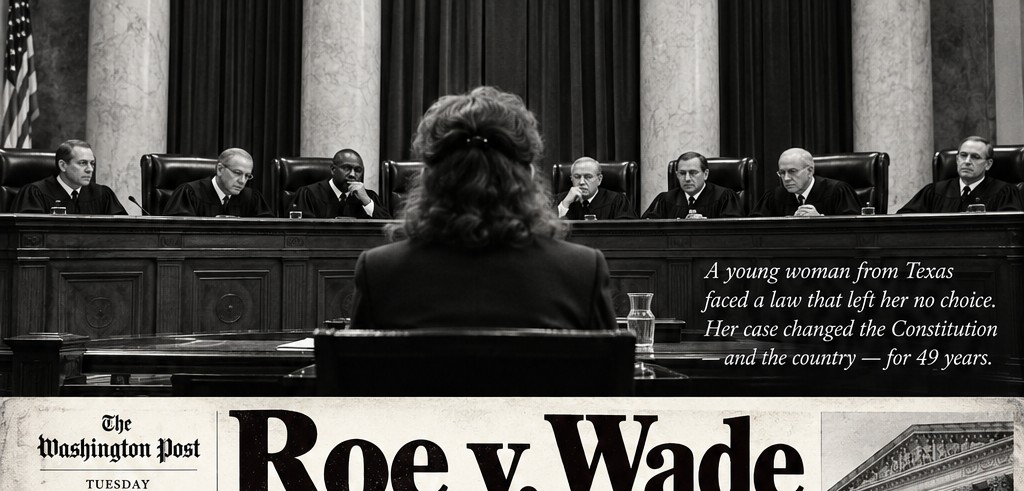
The woman. The Texas law. The constitutional decision that lasted 49 years.
THE CONSTITUTIONAL RECORD · JANUARY 22, 1973
SUPREME COURT STRIKES DOWN TEXAS ABORTION LAW
Roe v. Wade · 410 U.S. 113 · 7–2 decision · Opinion by Justice Harry Blackmun
THE CAUSATION CHAIN
From Texas law to constitutional reversal
1854Texas abortion restrictions enter state law
1868Fourteenth Amendment ratified
1965Griswold v. Connecticut
1969McCorvey’s pregnancy in Texas
1970Roe lawsuit filed
1973Roe decided, 7–2
1992Casey modifies Roe’s framework
2022Dobbs overrules Roe and Casey
The original Roe holding was overruled in 2022. Dates describe legal history, not current nationwide abortion rules.
THE STORY BEHIND THE DECISION
Why did this case reach the Supreme Court?
Before Roe became a national argument, it was a lawsuit brought by a woman whose circumstances collided with a Texas criminal statute. Follow the person, the legal barrier, the constitutional argument, the decision, and its reversal.
01
THE ROE STORY
The Person
Norma McCorvey was a young woman in Dallas who became pregnant in 1969. Under the pseudonym Jane Roe, she challenged Texas abortion restrictions with attorneys Linda Coffee and Sarah Weddington. McCorvey gave birth before the Supreme Court ruled; the child was placed for adoption.
02
THE ROE STORY
The Place and Time
Texas criminal statutes generally prohibited abortion, apart from a narrow exception to save the pregnant woman’s life. Laws differed across states. Geography and money affected the practical options available to someone seeking a procedure.
03
THE ROE STORY
The Gap
Roe challenged Texas laws that exposed abortion providers to criminal penalties. The legal dispute asked whether state regulation could prohibit the procedure when a pregnant woman asserted a constitutionally protected liberty.
04
THE ROE STORY
The Constitutional Root
The Fourteenth Amendment, ratified in 1868, forbids states to deprive people of liberty without due process of law. It does not expressly mention abortion. Roe drew on earlier privacy decisions, including Griswold v. Connecticut (1965), to interpret protected liberty more broadly.
05
THE ROE STORY
The Road to the Court
Roe filed suit in 1970. A three-judge federal court found the Texas provisions unconstitutional but declined an injunction. The Supreme Court heard argument in 1971, reargument in 1972, and issued its decision on January 22, 1973.
06
THE ROE STORY
The Decision
In a 7–2 decision, Justice Harry Blackmun wrote that constitutional privacy encompassed a qualified right to terminate a pregnancy. The Court established a trimester-based framework. Justices Byron White and William Rehnquist dissented, disputing the constitutional basis for the Court’s intervention.
07
THE ROE STORY
The Aftermath
Roe constrained state abortion prohibitions but did not end litigation or political conflict. McCorvey later became publicly associated with the anti-abortion movement; later accounts of her views remain contested and must be attributed carefully.
08
THE ROE STORY
The Chain Continues
Planned Parenthood v. Casey (1992) preserved the central pre-viability protection while replacing Roe’s trimester approach with an undue-burden standard. Dobbs v. Jackson Women’s Health Organization (2022) overruled Roe and Casey. Dobbs did not itself create a nationwide abortion ban.
READ THE RECORD
Primary documents
Examine the judicial opinions and oral-argument materials. Other trial documents and historical statutory sources remain identified as pending in the research record below.
OPEN THE VAULT RESEARCH RECORDExisting constitutional causation, procedural sections, research placeholders and receipt index · 20 sections preserved
THE FIRST QUESTION IN EVERY VAULT CASE
CONSTITUTIONAL CAUSATION
Why does the record you are about to read exist? We begin with the person, the real-world circumstance, the government law or action that created the barrier, the need for legal assistance, and the constitutional question that followed.
Roe’s opening question: How did Norma McCorvey’s pregnancy, Texas criminal abortion law, and the legal risk faced by physicians become a federal constitutional challenge under the Fourteenth Amendment?
01PERSON
Norma McCorvey, identified in the litigation as Jane Roe.
02CIRCUMSTANCE
A pregnancy and a desire to obtain an abortion.
03LEGAL BARRIER
Texas criminal statutes restricted abortion and exposed providers to prosecution.
04LEGAL ASSISTANCE
A constitutional challenge required attorneys, a plaintiff and federal jurisdiction.
05LAWSUIT
Roe sought declaratory and injunctive relief against enforcement.
06CONSTITUTIONAL QUESTION
Whether the Fourteenth Amendment limited Texas’s power to enforce those statutes.
01
Why This Case Exists
Before Roe became a constitutional symbol, it was a lawsuit challenging Texas criminal statutes. This section establishes the actual chain of events and separates contemporaneous records from accounts given years later.
02
The Real-World Backstory
This is where the finished record will answer the questions other case summaries skip: when McCorvey learned she was pregnant, what medical or personal options she pursued, whom she contacted, what she was told, and which source establishes each event.
Norma McCorveyPlaintiff · “Jane Roe”Henry WadeDallas County District Attorney · DefendantSarah WeddingtonCounsel for RoeLinda CoffeeCounsel for Roe
04
The Triggering Law
The finished section will reproduce the historical Texas statutes actually challenged, identify their penalties and exceptions, explain who enforced them, and preserve the version in force when the complaint was filed.
05
Finding Legal Assistance
This section will document how McCorvey came into contact with Coffee and Weddington, why she became the named plaintiff, what relief counsel sought, and what the available records do—and do not—prove about that process.
06
The Lawsuit Begins
Complaint, parties, jurisdiction, standing, claims, requested declaration, requested injunction and the defendant’s response will appear together rather than being scattered across unrelated pages.
07
Procedural Path
Real-world conflict→Federal complaint→Three-judge district court→Supreme Court appeal→Argument→Reargument→Decision→Later cases
08
Chronological Timeline
Before filing
Pregnancy, attempted options, attorney contact and preparation of the constitutional challenge.
District court
Pleadings, motions, evidence, decision and relief.
Supreme Court
Jurisdictional filings, first oral argument, reargument, conference and opinions.
After Roe
Casey, later abortion decisions, Dobbs and current legal status.
09
Questions Presented
The final page will reproduce the parties’ questions from their filings, then place the Court’s answers beside pinpoint citations to the decision.
10
Constitutional Provisions
Fourteenth Amendment due process, liberty and the privacy doctrine developed in earlier cases. Each provision and precedent will be connected to its own Vault record.
11–14
The Court Record
Historical statutes, lower-court record, Supreme Court briefs, oral arguments, majority opinion, concurrences and dissents—kept as separate documents and arranged chronologically.
15
Primary-Source Documents
Supreme Court opinionUnited States Reports · Library of Congress PDFOriginal complaintSource location reservedDistrict-court decisionSource location reservedParty briefsSource locations reservedOral argumentsTranscript and audio locations reservedHistorical Texas statutesAuthenticated source location reserved
16–17
What Changed and What Followed
Rule before Roe → rule announced in Roe → modification in Casey → overruling in Dobbs. Later cases and legislation will be presented in chronological order.
18
Current Legal Status
Roe v. Wade was overruled by Dobbs v. Jackson Women’s Health Organization in 2022. The completed page will separate Roe’s historical importance from its present precedential force.
19
Ask This Case
The future case researcher will answer only from records indexed to this case and will display the documents used to produce every answer.
20
Complete Receipt Index
Every assertion in the final summary will map to a human-readable and machine-readable source entry.